Overview
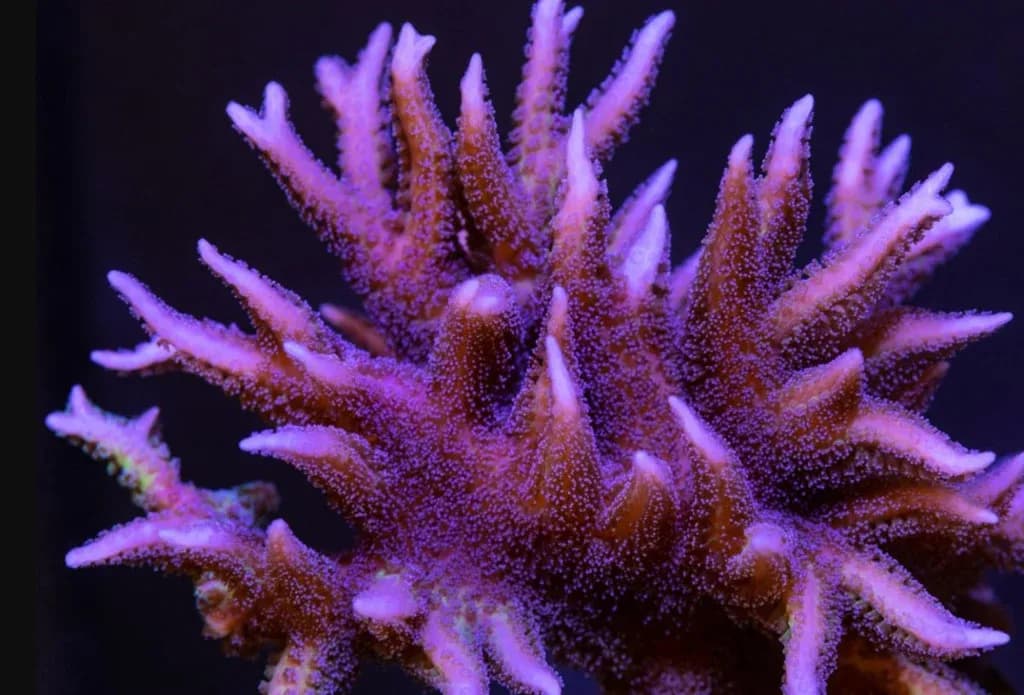
Seriatopora hystrix, the Birdsnest coral, is a small-polyp stony coral built from fine, tightly-packed branches that taper to sharp, needle-like tips — the tangled 'bird's nest' look that gives it its name. It's a popular first or second SPS because it's noticeably more forgiving than Acropora while still offering that classic branching SPS form and quick, satisfying growth. Common colours include pink, salmon, cream and green, often with paler growth tips.
The main thing to respect is its fragility. The branches are thin and brittle and snap easily when handled, and while that makes it delicate to move, it also makes it very easy to frag and share. In the right spot a Birdsnest grows fast and fills out into a dense, attractive bush.
As one-of-one WYSIWYG livestock, the exact colony or frag you see is the one you take home, with its own colour and shape. Expect some colour shift as it acclimates to your lighting and system over the following weeks.
Placement & neighbours
Place Birdsnest in the middle of the tank to start, on secure rockwork, where it gets moderate-to-strong light and — importantly — strong, turbulent flow. It's a peaceful coral that competes by growing rather than stinging, so it won't harm neighbours, but its delicate branches are easily damaged by more aggressive corals. Give it a little clearance so nothing grows into it or shades it.
Because it grows quickly and densely, leave room for it to expand and don't tuck it where it will shade corals behind it. Keep it well away from aggressive LPS such as Euphyllia and torch corals whose sweeper tentacles will burn the fine branches, and away from mat-forming softies that could creep onto its base.
Health & acclimation
Handle Birdsnest gently — the branches snap easily, so hold it by the base or plug when moving it. Acclimate as you would any SPS, matching temperature and salinity and increasing light gradually to avoid bleaching. Coral-dip new pieces before adding them, and inspect for the small, well-camouflaged Seriatopora-associated predators, including tiny nudibranchs and 'black bugs' that match the branch colour, plus red flatworms settling among the branches. The characteristic warning sign is rapid tissue loss where the coral goes from healthy to bare white skeleton in a day or two — this 'burning' from the base or centre outward is usually triggered by an alkalinity or parameter swing, or by low flow letting detritus settle among the branches. If it starts, frag healthy tips promptly to save the colony.
Frequently asked questions
Is Birdsnest a good beginner SPS?
Why does my Birdsnest keep breaking?
How much flow does it need?
My Birdsnest suddenly turned white — what happened?
How much light does it need?
Does it sting other corals?
Care guidance is drawn from our own experience — every coral is an individual, so treat it as a starting point, not a guarantee. Not sure if a coral suits your system? Come ask us in store.