Overview
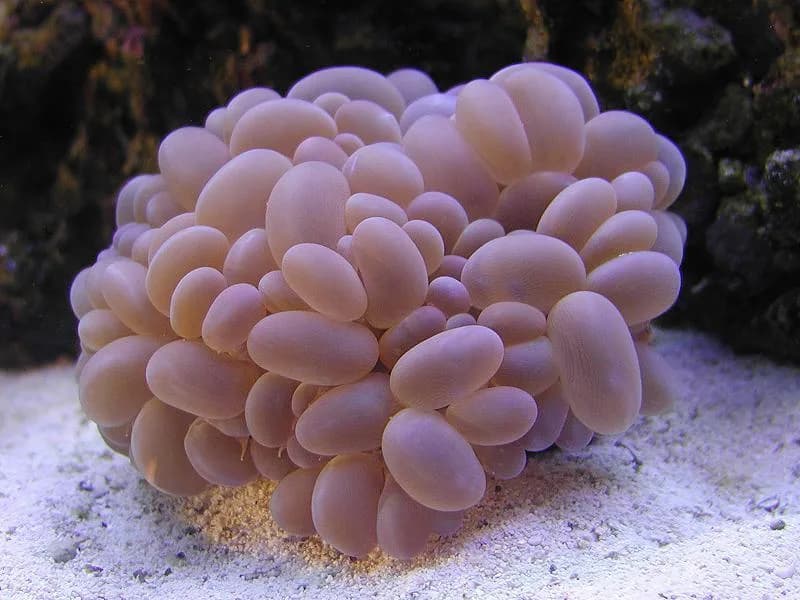
Bubble Coral is instantly distinctive for its grape-like clusters of translucent vesicles that inflate during the day to protect the skeleton and aid photosynthesis, then deflate at night to reveal long feeding tentacles. This dramatic day-to-night transformation makes it one of the more visually engaging LPS corals to keep.
Colouration is usually a soft white, cream or pale green, and the bubbles themselves can catch and diffuse aquarium lighting attractively. Each colony is a one-of-one specimen, with bubble size and shape varying between individuals.
It requires a slightly more considered placement than easier LPS due to its sensitivity to strong flow and its potent sting at night.
Placement & neighbours
Bubble Coral extends long sweeper tentacles at night that carry a strong sting, capable of damaging neighbouring corals, so give it generous clearance (20 cm or more) in all directions, including from corals on higher rock shelves above it.
Best placed low in the tank on the sand or lower rockwork where flow is gentle; strong or direct flow can prevent the bubbles from inflating properly and stresses the coral over time.
Health & acclimation
Drip acclimate slowly and handle the coral gently, since the vesicles can rupture with rough handling (a ruptured bubble is not fatal but should be watched for infection). A coral dip on introduction is recommended to check for pests. Provide low, indirect flow immediately after introduction and avoid moving the coral once settled, as bubble corals dislike being relocated repeatedly.
Frequently asked questions
Why do the bubbles disappear at night?
Is Bubble Coral dangerous to other corals?
What if a bubble gets popped or damaged?
Why won't the bubbles inflate properly?
Can Bubble Coral be fed directly?
Care guidance is drawn from our own experience — every coral is an individual, so treat it as a starting point, not a guarantee. Not sure if a coral suits your system? Come ask us in store.