Overview
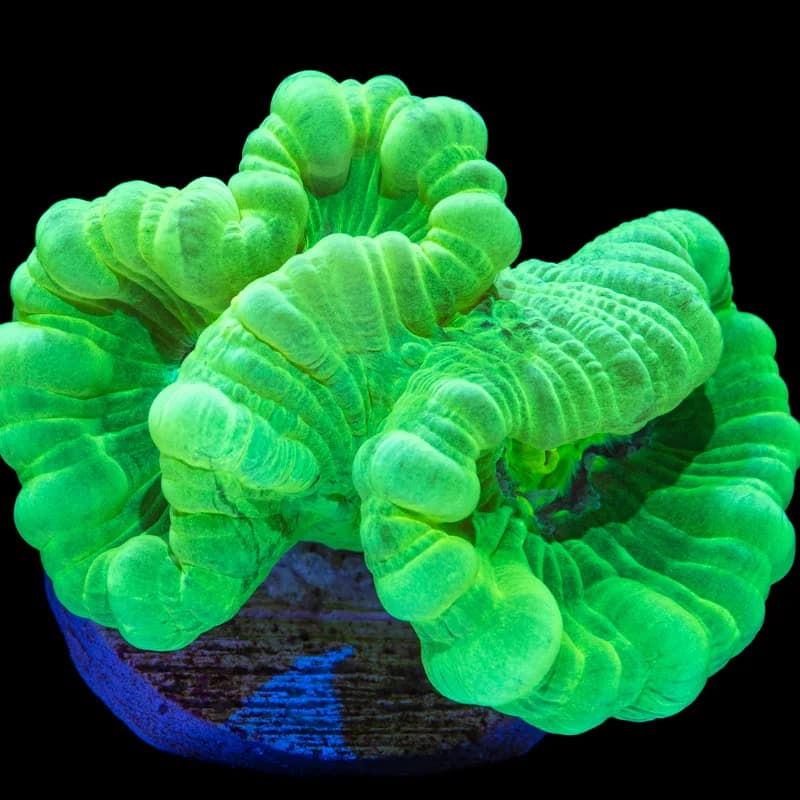
Candy Cane Coral, also known as Trumpet Coral, is a hardy and widely recommended entry-level LPS named for the striped, candy-cane-like pattern on its polyp centres. It forms clusters of rounded heads on short branching stalks and multiplies readily under stable conditions.
Colours are usually green or brown with contrasting stripe patterns and bright polyp mouths, giving good visual interest without being a demanding coral to keep. It's one of the most forgiving LPS options and a common recommendation for those new to stony corals.
Colonies split naturally over time, with new heads forming at the base as the coral matures, making it one of the easier corals in the hobby to propagate.
Placement & neighbours
Candy Cane Coral is peaceful and doesn't produce significant sweeper tentacles, so it can be placed closer to neighbours than most LPS, though some clearance is still worthwhile as colonies expand over time.
Best kept lower in the tank on the sand bed or lower rockwork with moderate, indirect flow; it tolerates a fairly wide range of conditions, which is part of its appeal for beginners.
Health & acclimation
Drip acclimate over 20-30 minutes; Candy Cane is comparatively tolerant of acclimation but a gradual approach reduces stress. A brief coral dip on introduction is good practice to remove any hitchhiking pests. Watch for tissue recession at the base of heads, which is usually a sign of low flow allowing detritus to settle, or unstable alkalinity.
Frequently asked questions
Is Candy Cane Coral good for a first LPS?
Does Candy Cane Coral sting other corals?
How do I propagate Candy Cane Coral?
Why are the heads not opening fully?
What lighting does Candy Cane Coral need?
Care guidance is drawn from our own experience — every coral is an individual, so treat it as a starting point, not a guarantee. Not sure if a coral suits your system? Come ask us in store.