
Overview
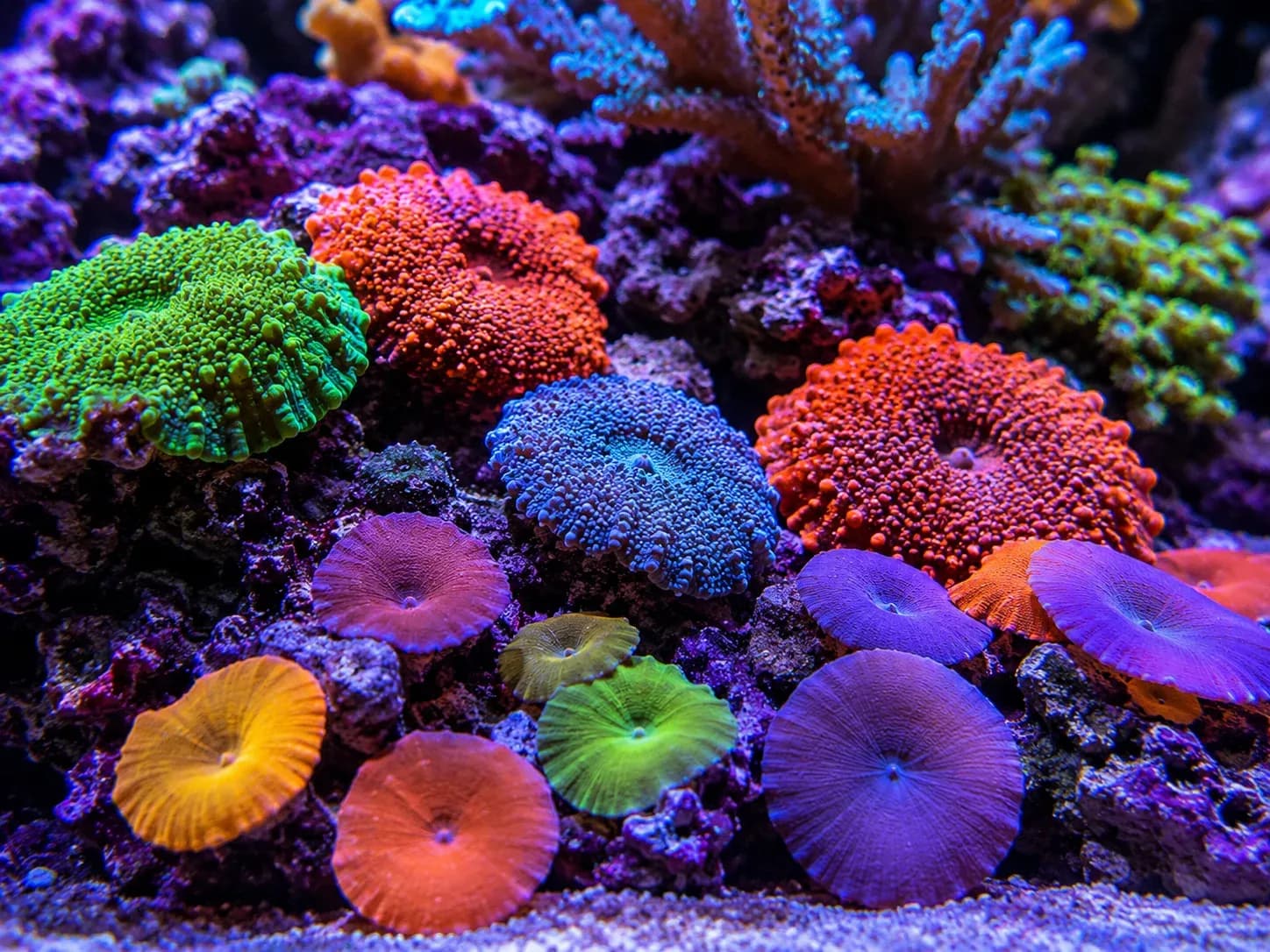
Discosoma mushrooms (still often sold under the old name Actinodiscus) are among the hardiest and most beginner-friendly corals available. Technically corallimorphs rather than true corals, they grow as flat, disc-shaped polyps attached to rock, with smooth or lightly textured surfaces in a wide range of colours from reds and greens to blues and purples. They ask very little and tolerate the kind of lower-light, lower-flow conditions that many other corals dislike.
They're an ideal first coral and a great way to fill shaded, low-flow areas of a reef where fussier corals won't thrive. A patch of colourful mushrooms multiplying across a rock is a low-effort, high-reward result for a new reefer. They also do well under modest lighting on smaller or budget setups.
As one-of-one WYSIWYG livestock, the exact piece you see is the one you take home, with its own colour and pattern. Mushroom colour and how far the discs open can change noticeably as they settle into your lighting and flow.
Placement & neighbours
Discosoma mushrooms are peaceful — they don't carry stinging sweeper tentacles — and compete mainly by slowly spreading across rock. That makes them easy, low-drama tankmates, though a vigorous patch can gradually encrust outward, so give it a little room. Place them low in the tank in a shaded, low-flow spot; that's genuinely where they do best, not just where they'll tolerate being.
The main compatibility note is that they prefer calm conditions, so keep them away from strong flow and from bright, high-light zones meant for SPS. They coexist happily with other soft corals, zoas and LPS given some space. If a mushroom is unhappy with its position it will simply detach and move, so the coral often sorts out its own placement over time.
Health & acclimation
Discosoma is extremely hardy and simple to acclimate — match temperature and salinity; it isn't demanding about light while settling, and if anything prefers lower light from the start. It has very few pests, though it's worth a quick inspection and gentle dip for the occasional mushroom-eating nudibranch or bristleworm hiding in the base. The behaviour to understand is that an unhappy mushroom will detach from its rock and drift to a spot it prefers — usually somewhere with less light or flow — which is normal rather than a sign of disease, though it's a hint the original position was too bright or too turbulent. A mushroom that stays shrivelled, curled tightly, or shows a gaping mouth for an extended period points to conditions being off, most often too much light or flow.
Frequently asked questions
Are Discosoma mushrooms good for beginners?
How much light and flow do they need?
Why did my mushroom detach and move?
Do I need to feed them?
How do they spread or reproduce?
Why is my mushroom shrivelled or curled up?
Care guidance is drawn from our own experience — every coral is an individual, so treat it as a starting point, not a guarantee. Not sure if a coral suits your system? Come ask us in store.