Overview
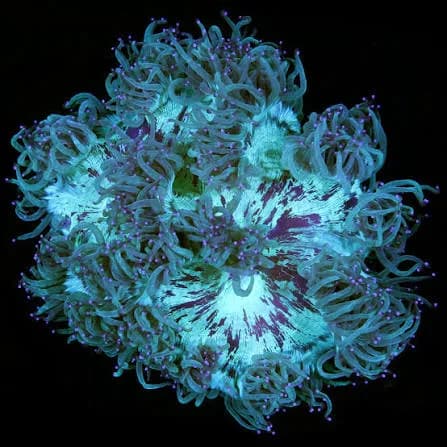
Catalaphyllia jardinei, the Elegance Coral, is a large solitary LPS famous for its flowing, anemone-like tentacles tipped in pink or purple and its brightly coloured, often striped oral disc. It is a free-living coral — the polyp sits on a conical skeleton that rests on the substrate rather than attaching to rock — and a well-expanded specimen makes a striking, animated centrepiece that sways in the current.
Elegance has a chequered history in the hobby. From the early 2000s many imported specimens, mostly from Indonesia, succumbed to a poorly understood wasting condition often called 'Elegance Coral Disease', which badly hurt the coral's reputation. Australian-collected Elegance, by contrast, has proven far hardier and more reliable, and is the reason the coral is once again considered a keepable, long-lived animal when sourced well. This is very much a case where origin matters.
As one-of-one WYSIWYG livestock, the exact polyp you see is the one you take home, with its own unique tentacle colour and disc pattern. Expect some shift in colour and expansion as it acclimates to your lighting and system over the following weeks.
Placement & neighbours
Treat the Elegance as an aggressive coral. It carries long, potent sweeper tentacles that sting anything within reach, and its fully expanded reach is much larger than its skeleton suggests. Place it alone on the sand bed with a generous clear margin all around — think of the space a small anemone would need — so that no neighbour, including other LPS, gets stung when it inflates or sweeps at night.
Because it's free-living and sits on the substrate, keep it away from the base of rockwork where corals could be caught in its tentacles, and don't place it directly downstream of other stinging corals like Euphyllia, which can burn it in turn. Give it room and it's a superb feature coral; crowd it and it will damage its neighbours or be damaged itself.
Health & acclimation
Source is the single most important health factor with this coral — choose Australian-collected, well-expanded specimens and avoid any showing tissue recession, a gaping mouth, or 'melting' tissue. Acclimate gently, matching temperature and salinity over 20–30 minutes and keeping it under low light at first, then settle it onto clean sand. A gentle coral dip is reasonable, but handle it minimally as the tissue is delicate. Watch closely for the early signs of the wasting condition and for brown jelly, both of which can progress quickly; also inspect for LPS-eating flatworms and predatory snails. A healthy Elegance inflates fully most of the day and feeds readily — a polyp that stays deflated or develops receding tissue needs prompt attention to placement, flow and water stability.
Frequently asked questions
Why does the Elegance Coral have a bad reputation?
Where should I place it — sand or rock?
Does it sting other corals?
How much light and flow does it need?
Do I need to feed it?
Is it suitable for beginners?
Care guidance is drawn from our own experience — every coral is an individual, so treat it as a starting point, not a guarantee. Not sure if a coral suits your system? Come ask us in store.