Overview
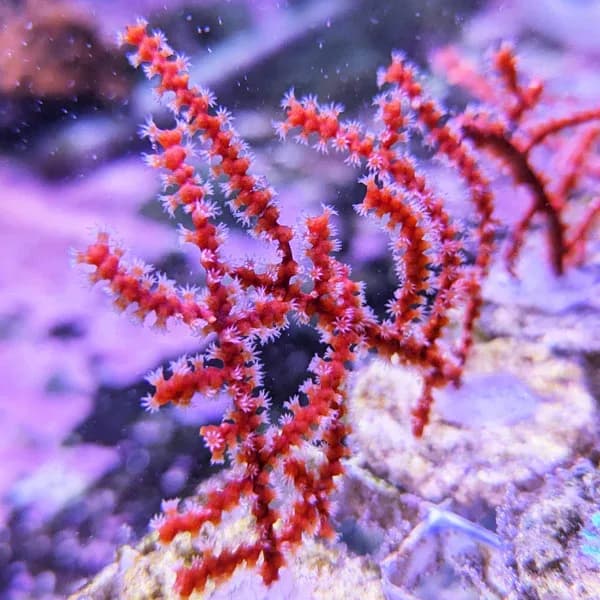
Gorgonian sea fans are branching soft corals built on a flexible internal skeleton, growing as a flat, net-like fan that orients itself across the current to catch food and light. The true genus Gorgonia comprises the well-known Caribbean sea fans, though 'gorgonian' is used loosely in the hobby for a wide range of fan and whip corals from both the Atlantic and Indo-Pacific. Their elegant, tree-like structure makes them a striking, architectural addition to a reef.
The single most important thing to establish before buying any gorgonian is whether it's photosynthetic or non-photosynthetic (NPS), because it completely changes the care. Photosynthetic sea fans — usually the tan, brown and purple-brown types — get much of their energy from light and are manageable for an intermediate reefer. Brightly coloured red, orange and yellow NPS gorgonians have no useful zooxanthellae, must be fed heavily and frequently, and are genuinely advanced, difficult animals that starve slowly in most tanks. We'll always tell you which type a given piece is.
As one-of-one WYSIWYG livestock, the exact colony you see is the one you take home. This entry focuses on the more keepable photosynthetic sea fans; ask us before committing to an NPS species.
Placement & neighbours
Gorgonians are peaceful — they don't sting neighbours with sweeper tentacles — and compete only for space and, importantly, for water flow. Site the fan out in open water where strong current passes across its face, ideally aligned so flow moves through the plane of the fan rather than edge-on. A mid-water position on rock, standing proud of surrounding structure, works well.
The key is not to crowd it, both so it gets clean flow and so its branches don't rub against neighbours, which damages the tissue. Keep faster-growing or encrusting corals and nuisance algae away from its base, since anything that overgrows the branches will kill the tissue beneath. It coexists happily with most corals given open space and good current.
Health & acclimation
The number-one killer of gorgonians is tissue fouling — algae, cyanobacteria or detritus settling on the branches and smothering the tissue — so strong, clean flow and good tank hygiene matter more than anything else. Acclimate normally, and critically, never expose the colony to air when moving it, as trapped air in the branches causes tissue death that then spreads. Handle only by the base or holdfast. Watch for bare skeleton appearing where tissue has receded, and for algae or cyano gaining a foothold on the branches; act quickly by improving flow and gently clearing fouling, as recession spreads fast once it starts. A healthy gorgonian has its polyps extended and its tissue firm and fully covering the skeleton. There are few specific pests, but a shrinking, receding, or bare-branched colony needs immediate attention to flow and water quality.
Frequently asked questions
Is this gorgonian photosynthetic or does it need feeding?
Why do gorgonians need such strong flow?
Why is my gorgonian losing tissue and showing bare skeleton?
Are gorgonians suitable for beginners?
How do I handle and mount one safely?
Care guidance is drawn from our own experience — every coral is an individual, so treat it as a starting point, not a guarantee. Not sure if a coral suits your system? Come ask us in store.