Overview
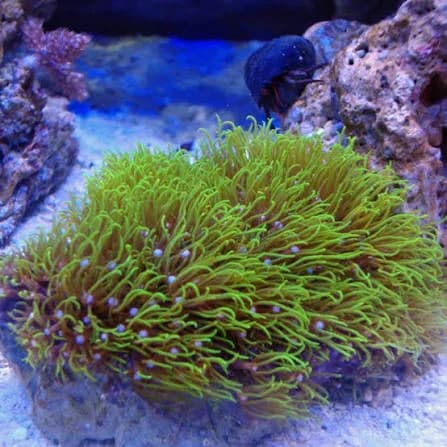
Green Star Polyps, or GSP, is a hardy encrusting soft coral built from a purple rubbery mat studded with bright green, star-shaped polyps. When open, a healthy patch looks like a glowing green lawn, and the vivid colour under blue light makes it a hobby favourite. It's about as tough and beginner-proof as corals get — undemanding on light, flow and water quality, and quick to establish.
Honesty is important here, because GSP's great strength is also its main danger: it spreads aggressively. The purple mat encrusts across rock, sand, glass, plumbing and even up onto other corals, and once established it's very difficult to fully remove. Many experienced reefers will only keep it on an isolated island rock with open water or bare glass around it, precisely because it can take over an aquascape.
As one-of-one WYSIWYG livestock, the exact piece you see is the one you take home. Colour can shift a little as it settles, and it typically 'greens up' nicely once acclimated to your lighting.
Placement & neighbours
Physically GSP is peaceful — it has no stinging sweeper tentacles — but it competes ruthlessly for space, encrusting over and smothering slower neighbours, so in practical terms it's best treated as semi-aggressive. It will happily grow onto the base of other corals and across rock, shading and overtaking anything in its path.
The key to keeping it is isolation. Place it low, on its own rock or an island separated by sand or bare glass that the mat can't easily bridge, rather than in the middle of a mixed reef. Leave a clear barrier around it and check its edges periodically, trimming back any mat that starts creeping toward other corals. Given its own space it's a striking, low-maintenance feature; given a mixed rockscape it can become a long-term nuisance.
Health & acclimation
GSP is extremely hardy and simple to acclimate — just match temperature and salinity; it isn't fussy about light during settling. A gentle dip is fine, and it has very few pests of concern. Newly added or freshly fragged GSP often stays closed with the mat sealed shut for several days to a week before the polyps emerge, which is completely normal and not a sign of trouble — give it time and stable conditions. Genuine problems are rare and usually show as a mat that stays sealed for weeks or begins to rot and lift away from the rock, which points to very poor water quality or being smothered by algae or detritus. Good flow over the colony helps keep it clean and open.
Frequently asked questions
Is Green Star Polyps good for beginners?
My new GSP hasn't opened in days — is it dead?
How do I stop it taking over my tank?
Does it sting or harm other corals?
How much light does it need for the best colour?
How do I remove it if I change my mind?
Care guidance is drawn from our own experience — every coral is an individual, so treat it as a starting point, not a guarantee. Not sure if a coral suits your system? Come ask us in store.