Overview
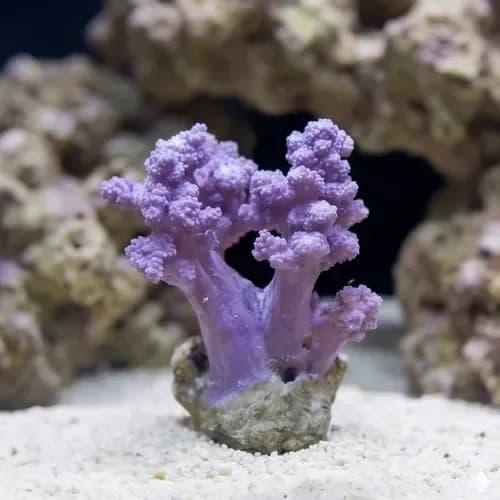
Capnella, the Kenya Tree coral, is a bushy, tree-shaped soft coral and one of the toughest, most beginner-friendly corals in the hobby. A central stalk divides into arms tipped with feathery polyps, giving it the look of a small, swaying tree. It's undemanding on light, flow and water chemistry, and grows quickly — which is both its main appeal and its main drawback.
Honesty matters with this one: Kenya Tree is notorious for being weedy. It propagates readily by dropping small branches that drift off, settle elsewhere, and grow into new colonies, so it can spread across a tank and pop up in places you didn't intend. That makes it rewarding and easy for a beginner, but worth thinking about before adding it to a carefully aquascaped mixed reef, as it can become difficult to fully remove.
As one-of-one WYSIWYG livestock, the exact coral you see is the one you take home. Colours are generally muted tans and browns, and appearance can shift a little as it settles into your lighting and system.
Placement & neighbours
Physically the Kenya Tree is peaceful and has no stinging sweeper tentacles, but like most soft corals it releases chemical compounds that can irritate or suppress nearby corals, particularly SPS, so it's best treated as semi-aggressive. Run carbon and a skimmer and keep up water changes to dilute its output, and don't crowd sensitive stony corals against it.
The bigger practical consideration is its spread. Because it reproduces by dropping branches that root wherever they land, give it its own area — ideally an isolated rock or island — rather than placing it in the middle of a mixed reef where it can encroach on neighbours. Place it low-to-mid in the tank with moderate flow, and be prepared to prune it to keep it in check.
Health & acclimation
Kenya Tree is extremely hardy and among the most forgiving corals to acclimate — simply match temperature and salinity; it isn't fussy about light during acclimation. A gentle soft-coral dip is fine, and it has few dedicated pests. Like other soft corals it will periodically deflate, shrink down and look limp for a day or two as it expels waste and sheds, then re-inflate — this is normal and not a cause for alarm. Genuine problems look different: a colony that stays collapsed for a week or more, or shows a rotting, disintegrating stalk, usually points to very poor water quality or physical damage. If anything, the more common 'health' issue keepers face is the opposite — controlling its growth rather than keeping it alive.
Frequently asked questions
Is Kenya Tree good for beginners?
Why does it keep spreading around my tank?
My Kenya Tree has shrunk and gone limp — is it dying?
Do I need to feed it?
Will it harm my other corals?
How do I get rid of it or keep it under control?
Care guidance is drawn from our own experience — every coral is an individual, so treat it as a starting point, not a guarantee. Not sure if a coral suits your system? Come ask us in store.