Overview
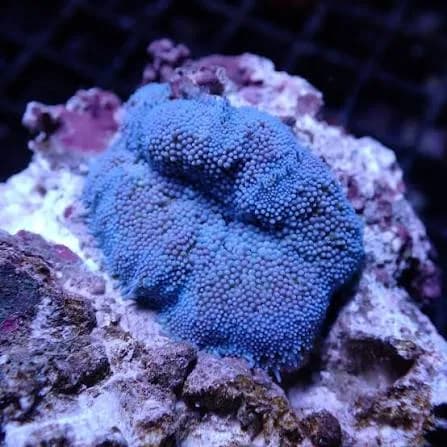
The Mini Maxi is a small carpet-type anemone — effectively a miniature relative of the big carpet anemones — that stays only a few centimetres across and comes in vivid, often fluorescent colours. Its short, dense tentacles give it the same plush, sticky 'carpet' texture as its giant cousins, but in a compact, nano-friendly package. The neon green, blue, orange and rainbow morphs are genuinely eye-catching under blue light.
Unlike the demanding full-size carpet anemones, the Mini Maxi is hardy and beginner-friendly. It anchors its foot into a rock crevice and generally stays put, tolerates a range of conditions, and is far more forgiving than a Gigantea or Bubble Tip. It isn't a natural clownfish host, so it's kept for its own colour and form rather than the clownfish relationship.
As one-of-one WYSIWYG livestock, the exact anemone you see is the one you take home, with its own unique colour. Bear in mind colour can look different once it settles under your own lighting, and these anemones split readily, so a single specimen can become several over time.
Placement & neighbours
Despite its small size, the Mini Maxi packs a surprisingly potent, very sticky sting and will capture and damage whatever it can reach — so treat it as semi-aggressive. It stings corals that contact it and can even trap small snails or fish that blunder onto it, so don't place corals within tentacle reach and be mindful of what shares its immediate area. Its small footprint limits the damage, but the sting itself is strong for its size.
Place it low, anchoring the foot into a rocky crevice where it gets moderate light and gentle flow. It's much less mobile than host anemones and usually stays where it settles, though it will move if unhappy, and it spreads by splitting, so a single anemone can multiply into a patch — bear that in mind in a small tank. Guarding pump intakes remains good practice even though it's far less prone to wandering into equipment than larger anemones.
Health & acclimation
Mini Maxis are hardy and acclimate well, but as with any anemone, choose specimens with a firmly attached foot, sticky tentacles, an intact (not gaping) mouth, and good colour, and avoid any that are detached, deflated, or gaping. Acclimate slowly, ideally by drip, since anemones dislike salinity and parameter swings, and add them only to a stable, cycled tank. They have few specific pests. The warning signs of trouble mirror other anemones — loss of stickiness, a persistently gaping mouth, deflation, expelling brown material, or detaching and drifting — and even a small dying anemone can foul a nano tank quickly, so remove any clearly failing specimen promptly. A healthy Mini Maxi stays inflated, sticky, and grabs food readily.
Frequently asked questions
Is the Mini Maxi easier to keep than a full-size carpet anemone?
Does it sting other corals?
Will it host clownfish?
Does it move around or spread?
How often should I feed it?
How much light does it need for the best colour?
Care guidance is drawn from our own experience — every coral is an individual, so treat it as a starting point, not a guarantee. Not sure if a coral suits your system? Come ask us in store.