
Overview
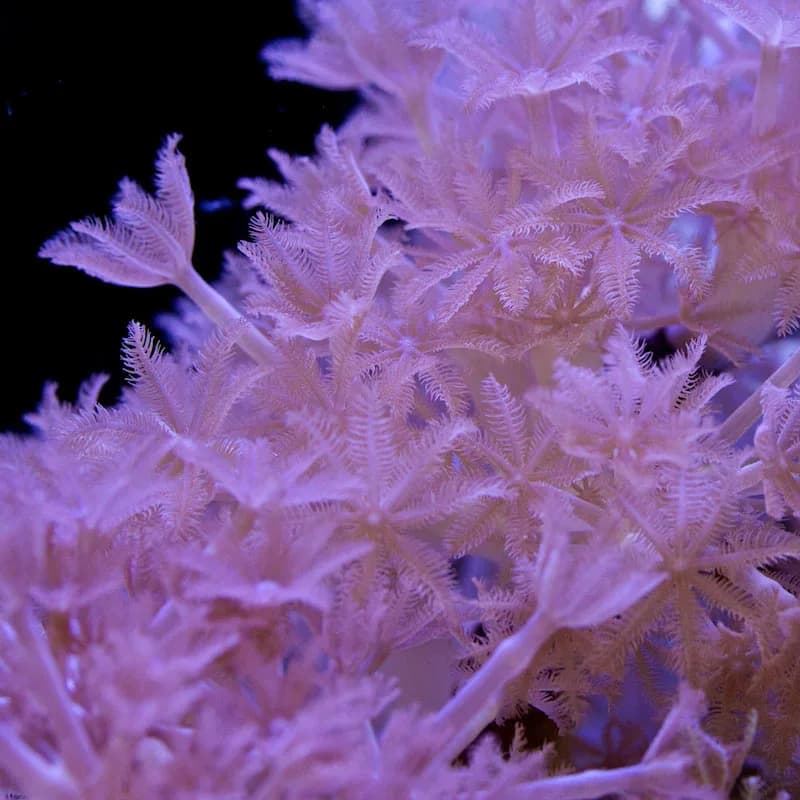
Pulsing Xenia is one of the most captivating corals in the hobby for a simple reason: its feather-tipped polyps open and close in a continuous rhythmic pulsing motion, like tiny grasping hands, all day long. No other common coral moves quite like it, and a thriving colony in constant motion is a real talking point. Colours are usually soft creams, tans, silvers and pale pinks — the appeal is the movement rather than bright colour.
Two honest caveats come with it. First, like several soft corals it's weedy: it grows and spreads quickly, encrusting outward and popping up around the tank, and can be hard to fully remove once established. Second, Xenia has a reputation for being unpredictable — colonies sometimes thrive and spread explosively, then melt away for no obvious reason, and the exact reasons aren't fully understood. It's easy to grow but not always easy to control or rely on.
As one-of-one WYSIWYG livestock, the exact piece you see is the one you take home. Pulsing strength and appearance often change as it settles into your lighting and flow.
Placement & neighbours
Physically Xenia is peaceful and doesn't sting, but like other soft corals it spreads aggressively and can encrust over rock and onto slower neighbours, so it's best treated as semi-aggressive in practice. It's also thought to contribute chemical compounds to the water like other softies, so carbon, skimming and water changes remain worthwhile in a mixed reef.
The main management task is containment. Give it its own rock or an island separated by sand or bare glass, rather than placing it in the middle of a mixed rockscape where it can march across everything. Place it low-to-mid in moderate flow — good flow actually encourages stronger pulsing — and trim or remove stray growth before it reaches other corals. Given its own space it's a mesmerising feature; given free rein it can overrun an aquascape.
Health & acclimation
Xenia is generally easy to keep alive and simple to acclimate — match temperature and salinity; it isn't demanding about light during settling. It has very few pests. The quirks to know are behavioural: newly added Xenia may stop pulsing and look shrunken for a few days before it settles and resumes, which is normal. Its less predictable trait is a tendency to occasionally 'melt' or crash rapidly, sometimes tied to very low nutrients, unstable parameters, or swings in alkalinity or salinity — Xenia often does better in tanks with some nutrients present rather than ultra-clean, heavily-stripped water. If a colony starts disintegrating, remove the affected tissue promptly, but there's usually enough spread elsewhere that it recovers. Stable conditions and not over-purifying the water are the best insurance.
Frequently asked questions
Why isn't my Xenia pulsing?
Is Xenia good for beginners?
Why did my Xenia suddenly melt away?
How do I stop it taking over my tank?
Do I need to feed it?
Does it sting other corals?
Care guidance is drawn from our own experience — every coral is an individual, so treat it as a starting point, not a guarantee. Not sure if a coral suits your system? Come ask us in store.