Overview
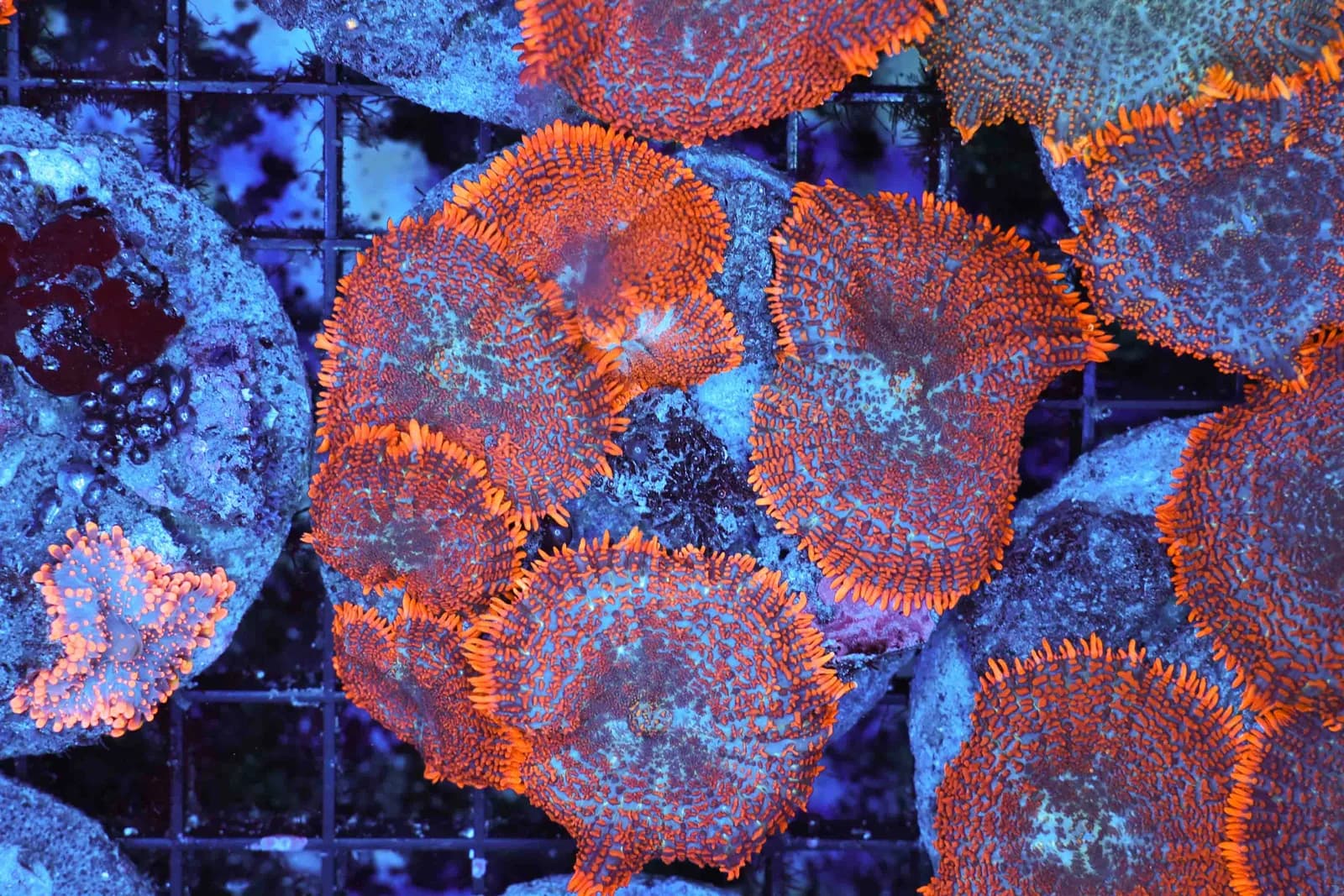
Rhodactis is a group of corallimorphs — mushroom relatives — with a textured surface that can be finely hairy, bumpy, or covered in the rounded vesicles that define the highly sought-after 'Bounce' mushrooms. They range from common, hardy green and purple hairy mushrooms right up to premium Bounce morphs that are among the most valuable single polyps in the hobby. Whatever the grade, they share the same easy, forgiving care.
They're an excellent beginner coral: tough, tolerant of a range of conditions, and quick to multiply once settled. Unlike the light-shy Discosoma, larger Rhodactis appreciate a bit more light to hold their colour, and many will take meaty food readily, which supports faster growth. A well-coloured cluster makes a genuine feature, and the premium morphs are as collectable as any coral we stock.
As one-of-one WYSIWYG livestock, the exact piece you see is the one you take home, with its own colour and texture. Rhodactis colour and how fully the polyp opens can shift as it acclimates to your lighting and flow.
Placement & neighbours
Rhodactis is peaceful toward other corals — it has no stinging sweeper tentacles — and competes only by slowly spreading across rock, so it's an easy mixed-reef tankmate. Place it low in the tank in moderate light and gentle flow, giving it a little room to encrust outward. Strong flow keeps the polyps from opening fully, so a calmer spot suits them.
One quirk worth knowing: large hairy Rhodactis can fold over and capture small prey, and there are occasional reports of big specimens trapping tiny fish or shrimp that settle on them at night. This is uncommon and not aggression toward corals, but it's worth siting a very large mushroom away from spots where small, sleepy fish or expensive shrimp might rest on it. Otherwise, keep it clear of aggressive LPS whose sweepers could sting it, and don't let faster corals overgrow it.
Health & acclimation
Rhodactis is hardy and straightforward to acclimate — match temperature and salinity; it handles a range of light but settle it in moderate light rather than intense. A gentle dip is worthwhile, and the main pests are mushroom-eating nudibranchs and bristleworms, plus the occasional predatory snail, so inspect the base. As with other mushrooms, an unhappy Rhodactis may detach and relocate to conditions it prefers — usually calmer or shadier — which is normal rather than a disease sign, though it's a hint the original spot was too bright or turbulent. A polyp that stays shrivelled, tightly curled, or shows a persistently gaping mouth for an extended period points to conditions being off, most often light or flow, or unstable water.
Frequently asked questions
Are Rhodactis mushrooms good for beginners?
What is a 'Bounce' mushroom?
How much light and flow do they need?
Should I feed them?
Can a big hairy mushroom really eat fish or shrimp?
Why did my Rhodactis detach and move?
Care guidance is drawn from our own experience — every coral is an individual, so treat it as a starting point, not a guarantee. Not sure if a coral suits your system? Come ask us in store.