Overview
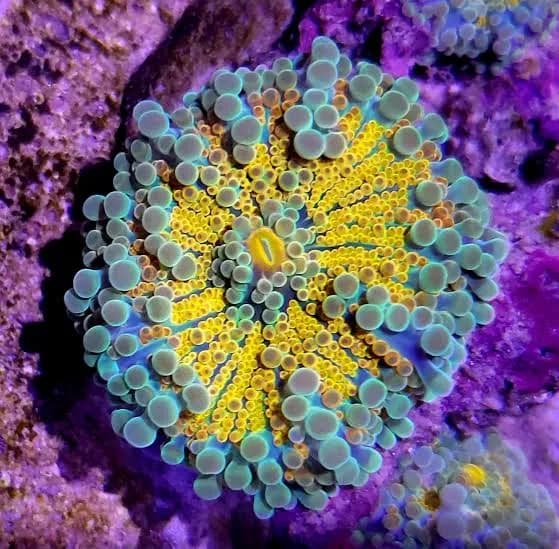
Ricordea yuma is a Pacific corallimorph — a mushroom relative — prized for its jewel-like colours and the covering of rounded, bubble-like vesicles that give the disc a beaded, textured look. Yumas come in some of the most vivid colours in the hobby, including electric blues, oranges, greens and multi-colour 'rainbow' morphs, often with a contrasting raised central mouth. They're one of the more collectable and sought-after mushrooms.
It's worth being clear that yuma (Pacific Ricordea) is generally considered a bit more demanding than its Caribbean cousin R. florida and than common Discosoma mushrooms. Yumas appreciate more light, cleaner and more stable water, and gentle handling, and they can be slower to settle. They're not difficult exactly, but they reward an established, stable tank rather than a brand-new one, which is why we class them as intermediate.
As one-of-one WYSIWYG livestock, the exact piece you see is the one you take home, with its own unique colour and pattern. Yuma colour and how fully the polyp inflates can shift noticeably as it acclimates to your lighting and system.
Placement & neighbours
Ricordea yuma is peaceful — it has no stinging sweeper tentacles — and competes only slowly for space, making it an easy, well-behaved tankmate. Place it low in the tank, on rock or in a rocky pocket, where it gets moderate light and gentle flow. It appreciates a stable spot where it isn't buffeted, as strong flow keeps the polyp from inflating fully.
The main compatibility consideration is protecting it rather than protecting its neighbours. Keep it clear of aggressive LPS whose sweepers could sting it, and don't let faster corals overgrow or heavily shade it. It sits comfortably alongside zoas, other mushrooms and calm LPS given a little space of its own.
Health & acclimation
Yumas reward careful selection and gentle handling — choose fully inflated, well-coloured specimens and avoid any that look shrunken, torn, or are gaping. Acclimate slowly, ideally by drip, as they're more sensitive to parameter and salinity swings than hardier mushrooms, and give them a stable, mature tank. A gentle dip is reasonable; the main pests are mushroom-eating nudibranchs and bristleworms, plus the occasional predatory snail, so inspect the base. The key warning signs are a polyp that stays deflated, curls up, develops a persistently gaping mouth, or begins to shrink and 'melt' — usually a response to unstable water, or to light or flow being wrong (too strong or too weak). Because a single detaching yuma can foul quickly, remove any clearly dying polyp promptly and check your parameters.
Frequently asked questions
What's the difference between Ricordea yuma and Ricordea florida?
Is Ricordea yuma suitable for beginners?
How much light does it need?
Should I feed it?
Why won't my yuma inflate or open up?
Does it spread quickly like other mushrooms?
Care guidance is drawn from our own experience — every coral is an individual, so treat it as a starting point, not a guarantee. Not sure if a coral suits your system? Come ask us in store.