
Overview
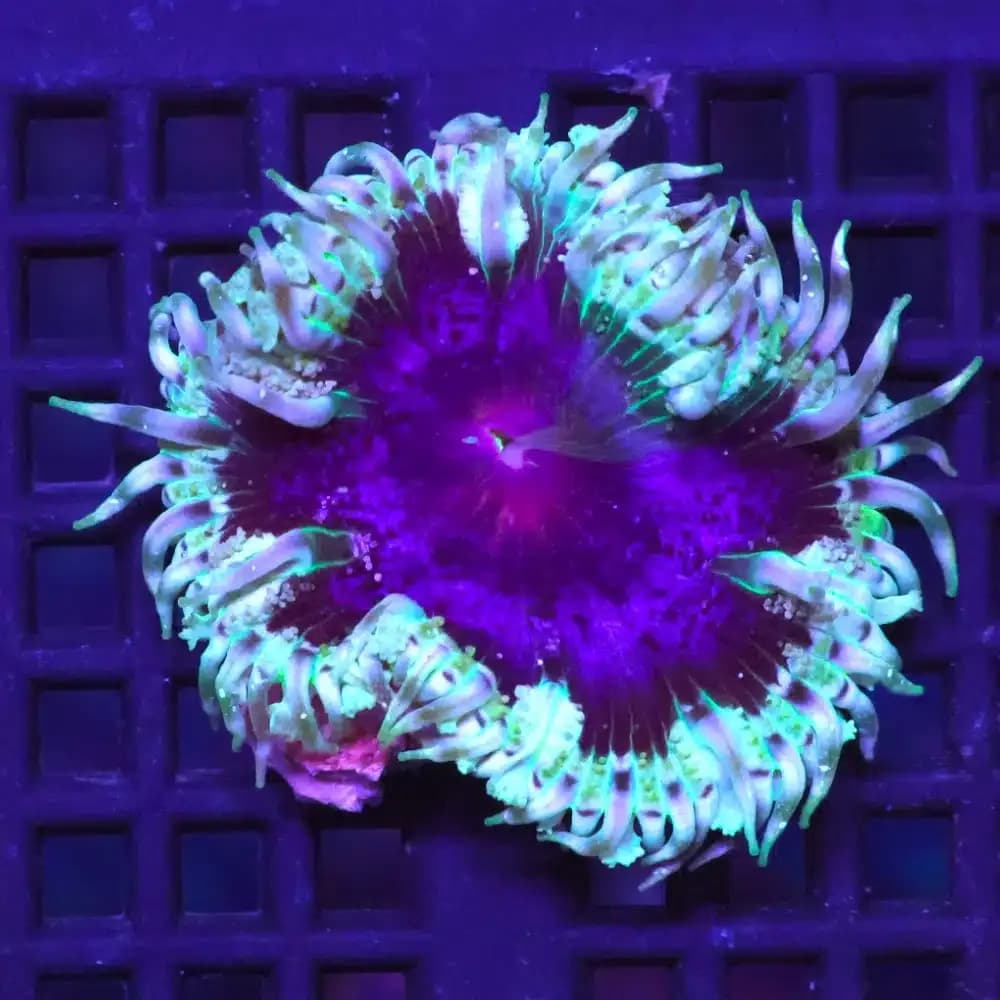
The Rock Flower Anemone is one of the best anemones for reefers who want the animal without the difficulty of a host anemone. It's a single polyp with a beautifully patterned oral disc and a ring of short tentacles, and it comes in an astonishing range of collectable colours — 'rainbow', 'ultra' and metallic morphs are highly sought after. Its foot anchors into a rock crevice or the sand bed, and unlike the big host anemones it generally stays where it settles.
Compared with Bubble Tips and carpet anemones, Rock Flowers are hardy, undemanding, and far less prone to wandering into powerheads, which makes them a sensible first anemone. They don't naturally host clownfish (clowns will occasionally adopt one, but it shouldn't be expected), so they're kept for their own colour and form rather than the clownfish relationship. A group of different morphs together makes a striking 'flower garden'.
As one-of-one WYSIWYG livestock, the exact anemone you see is the one you take home, with its own unique disc pattern and colour. Bear in mind colour can look different once it settles under your own lighting.
Placement & neighbours
Rock Flowers are more manageable than most anemones but still carry a sting, so it's sensible to treat them as semi-aggressive toward corals — don't let their tentacles contact neighbouring corals. Their sting is relatively mild compared with carpet anemones, and importantly they tolerate being kept close to one another, so multiple Rock Flowers can be arranged together in a dedicated patch, which isn't possible with most host anemones.
Place them low, anchoring the foot into a rocky crevice or nestled in the sand bed where they get moderate light and gentle flow. They're much less mobile than host anemones and usually stay put once settled, which greatly reduces the risk of them wandering into equipment — though it's still good practice to guard pump intakes. Keep valuable corals out of tentacle reach and otherwise they're easy, well-behaved tankmates.
Health & acclimation
Rock Flowers are hardy and generally ship and acclimate well, but as with any anemone, selection matters — choose specimens with a firmly attached foot, an intact (not gaping) mouth, and good colour, and avoid any that are detached, deflated, or have a blown-out mouth. Acclimate slowly, ideally by drip, since anemones are sensitive to salinity and parameter swings, and add them only to a stable, cycled tank. They have few specific pests. The warning signs of trouble are the same as other anemones — a persistently gaping mouth, deflation, expelling brown material, or detaching and drifting — and a dying anemone can foul water quickly, so remove any clearly failing specimen promptly. A healthy Rock Flower inflates its disc daily and grips readily when offered food.
Frequently asked questions
Are Rock Flower Anemones good for beginners?
Will a Rock Flower host my clownfish?
Do they move around like other anemones?
Can I keep several together?
How often should I feed one?
How much light do they need?
Care guidance is drawn from our own experience — every coral is an individual, so treat it as a starting point, not a guarantee. Not sure if a coral suits your system? Come ask us in store.