Overview
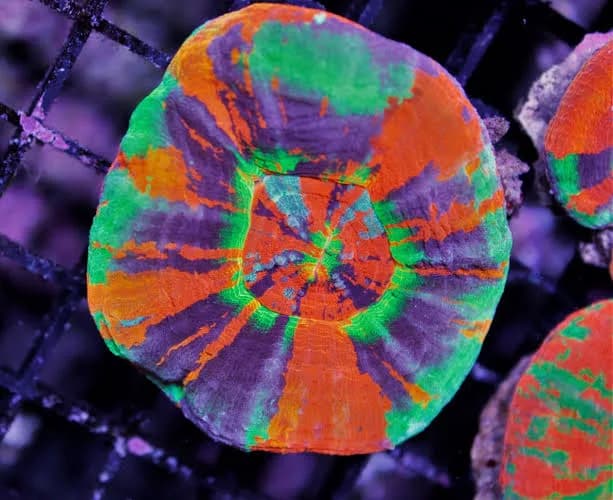
Homophyllia australis, still widely sold under its old name Scolymia australis, is the Australian button or doughnut coral — a solitary, single-polyp LPS and one of the most collectable corals in the hobby. Unlike branching or colonial corals, each specimen is a single fleshy polyp on a disc-shaped skeleton, and the appeal is almost entirely in the colour and pattern of that one polyp. The most striking multi-colour specimens, often called 'Master Scolys', command premium prices precisely because no two are alike.
They come from cooler southern Australian waters and are collected at depth, which shapes their care: they want low light, gentle flow, and a spot on the sand or low rockwork rather than a bright, high-flow position. Kept correctly they are hardy and long-lived, and a healthy Scoly will inflate into a smooth, colourful cushion that becomes a genuine centrepiece.
As one-of-one WYSIWYG livestock, the exact polyp you see is the one you take home — its colour, pattern and size are unique to that piece. Bear in mind that colour and inflation can shift as the coral settles into your own lighting and system over the following weeks.
Placement & neighbours
Place Homophyllia australis on the sand bed or low on the rockwork, in a shaded, low-flow position. Although it looks passive, it is a Lobophylliid and can extend sweeper tentacles, particularly at night, and will sting corals it can reach. Give it a clear margin — leave open space equal to at least the polyp's own diameter around it so a neighbour doesn't get burned when the coral inflates or sends out feeders.
It does not tolerate being overgrown or shaded by faster corals, so keep encrusting SPS, mushrooms and mat-forming softies well back. It sits happily alongside other calm, low-light LPS such as Acanthophyllia, Cynarina and other Scolymia/Homophyllia, provided each has its own space. Avoid housing it directly beneath aggressive Euphyllia or torch corals whose long sweepers can reach down onto it.
Health & acclimation
Acclimate gently — match temperature and salinity over 20–30 minutes and keep it out of bright light for the first day or two, as these are low-light animals collected from depth. A gentle coral dip is worthwhile to clear pests, but handle the polyp carefully because the tissue is soft and tears easily; never touch or squeeze the fleshy surface. The main pests are Scoly-eating and LPS-feeding flatworms, plus small predatory snails such as Pyramidellids, so inspect the underside of the disc and the skeleton edge closely. Watch for tissue recession at the skeleton margin or a persistently deflated polyp, which usually signals too much light, too much flow, or unstable parameters rather than disease.
Frequently asked questions
What's the difference between a Scolymia and a 'Master Scoly'?
Why won't my Scoly inflate properly?
Do I need to feed it, or is light enough?
How much light does it need?
Is it aggressive toward other corals?
Is Homophyllia australis suitable for beginners?
Care guidance is drawn from our own experience — every coral is an individual, so treat it as a starting point, not a guarantee. Not sure if a coral suits your system? Come ask us in store.