Overview
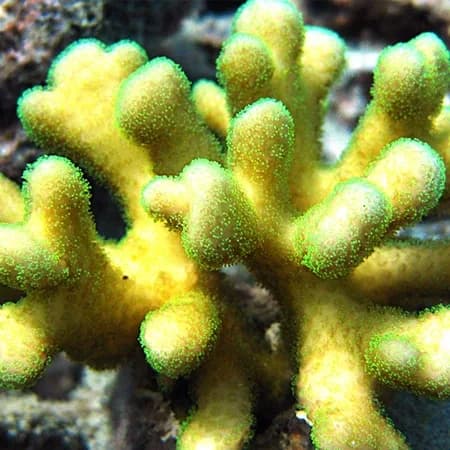
Stylophora pistillata is a hardy branching SPS with thick, blunt, club-shaped tips — quite different from the fine, needle-like branches of its Pocilloporid relative the Birdsnest. Along with Pocillopora and Montipora, it's one of the most forgiving small-polyp stony corals and a great choice for reefers taking their first steps into SPS. Colonies come in pink, purple, green and cream, and when the polyps are extended the whole colony takes on a soft, fuzzy look.
Its appeal is a combination of toughness and growth. Stylophora handles a wider range of conditions than Acropora and grows quickly once settled, thickening its stubby branches into a solid, rounded colony. The branches are sturdier than a Birdsnest's, so it's less prone to snapping when handled.
As one-of-one WYSIWYG livestock, the exact colony or frag you see is the one you take home, with its own colour and form. Expect some colour shift as it acclimates to your lighting and system over the following weeks.
Placement & neighbours
Place Stylophora in the middle of the tank on secure rockwork, where it gets moderate light and moderate-to-strong flow, then adjust upward once you see how it responds. It's a peaceful coral that competes by growing rather than stinging, so it won't harm its neighbours, and its sturdier branches shrug off minor contact better than most fine SPS.
It is a fast grower, so leave room for it to expand into a rounded colony and don't place it where it will shade corals behind it. Keep it clear of aggressive LPS such as Euphyllia and torch corals, whose sweeper tentacles will burn it, and away from mat-forming softies that could creep onto its base.
Health & acclimation
Stylophora is generally hardy and handles acclimation well — match temperature and salinity and increase light gradually to avoid bleaching. Its branches are sturdier than a Birdsnest's, but still handle it by the base or plug. Coral-dip new pieces and inspect for the small, well-camouflaged predators associated with Pocilloporid corals, including tiny nudibranchs that match the colony colour, plus red flatworms settling among the branches. As with other SPS, the main warning sign is rapid tissue loss exposing bare white skeleton, usually triggered by an alkalinity or parameter swing, or by low flow allowing detritus to settle in the colony. If recession starts, frag healthy tips promptly to preserve the colony.
Frequently asked questions
What's the difference between Stylophora and Birdsnest?
Is Stylophora good for beginners?
How much light and flow does it need?
Why did my Stylophora turn brown?
My colony suddenly lost tissue — what happened?
Does it sting other corals?
Care guidance is drawn from our own experience — every coral is an individual, so treat it as a starting point, not a guarantee. Not sure if a coral suits your system? Come ask us in store.