Overview
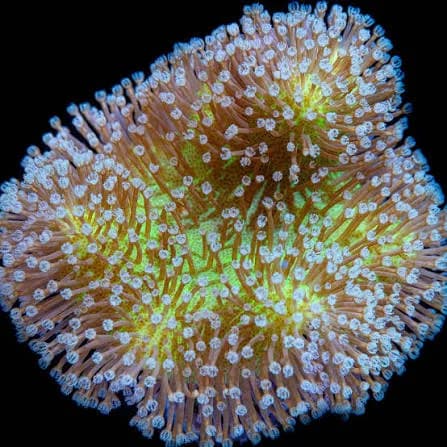
Sarcophyton, the Toadstool leather, is one of the hardiest and most recognisable soft corals — a thick stalk topped with a broad, mushroom-like cap covered in feeding polyps. It's a classic beginner coral: tolerant of a wide range of light and flow, undemanding on water chemistry, and quick to grow into an impressive centrepiece. Colours are typically muted tans, creams, yellows and greens, with the appeal coming from the flowing polyps and bold toadstool shape.
A large Toadstool becomes a genuine feature, its cap folding and undulating in the current with polyps extended like a field of fine fingers. It's forgiving of the beginner mistakes that would harm stony corals, which is a big part of why it's so widely recommended for a first soft coral.
As one-of-one WYSIWYG livestock, the exact coral you see is the one you take home, with its own shape and polyp colour. Expect some change in appearance as it settles into your lighting and system over the following weeks.
Placement & neighbours
Physically the Toadstool is peaceful — it has no stinging sweeper tentacles — but like most soft corals it wages chemical warfare, releasing terpenoid compounds into the water that can irritate or suppress nearby corals, especially SPS. For that reason it's best treated as semi-aggressive: give it space, run good carbon and skimming, and don't crowd sensitive stony corals right up against it.
Place it on rockwork in the lower-to-middle tank to start, allowing room for the cap to expand and for the coral to sway without brushing neighbours. It sits comfortably alongside other soft corals and is largely left alone by fish and inverts. In a mixed reef, dilution matters — adequate water volume, flow, carbon and water changes keep its chemical output from becoming a problem.
Health & acclimation
Toadstools are very hardy and ship well. Acclimate normally by matching temperature and salinity; they aren't fussy about light levels during acclimation. A gentle soft-coral dip is fine, but these corals have relatively few dedicated pests — the main thing to inspect for is Sundial snails and, occasionally, flatworms. The behaviour that alarms most new keepers is completely normal: Toadstools periodically deflate, close their polyps, and shed a waxy surface film (a process sometimes called 'sloughing') to clear off detritus and algae, often looking limp or 'melting' for a day or two before opening again brighter than before. Genuine trouble looks different — persistent failure to open over a week or more, a rotting stalk, or open lesions — and usually points to poor water quality or physical damage at the base.
Frequently asked questions
Why is my Toadstool closed up and looking like it's melting?
Is it good for beginners?
Do I need to feed it?
Will it harm my other corals?
How much light and flow does it need?
Can I frag or propagate it?
Care guidance is drawn from our own experience — every coral is an individual, so treat it as a starting point, not a guarantee. Not sure if a coral suits your system? Come ask us in store.