Overview
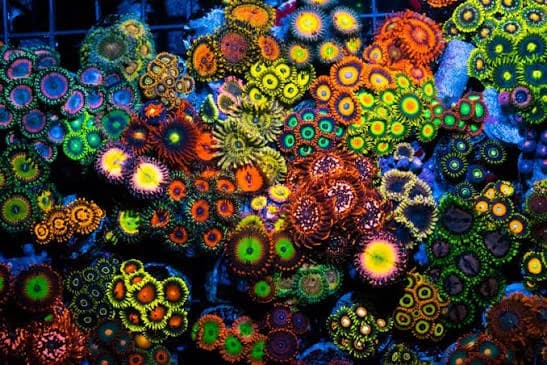
Zoanthids ('zoas') and Palythoa ('palys') are colonial button polyps that grow as a mat of individual disc-shaped heads, each with a ring of short tentacles around a central mouth. They come in an almost endless range of colours and patterns, and the named morphs — with hobby names like 'Rasta', 'Utter Chaos' and 'Fruit Loops' — are among the most collectable corals in the reef world. As a broad rule, Zoanthus tend to be smaller, brighter polyps while Palythoa are larger and often have a more speckled or muted look, but the two are cared for the same way.
They're a superb beginner coral: hardy, colourful, forgiving of a range of light and flow, and quick to multiply into an impressive colony. Their one serious caveat isn't about care difficulty but safety — these polyps can contain palytoxin, one of the most potent natural toxins known, so they must be handled with care (covered below).
As one-of-one WYSIWYG livestock, the exact frag or colony you see is the one you take home, with its specific morph and colour. Zoa colour and how far the polyps open can shift noticeably as they acclimate to your lighting and flow.
Placement & neighbours
Zoas and palys are essentially peaceful — they don't sting neighbours with sweeper tentacles — and they compete mainly by slowly encrusting and spreading across available surfaces. That makes them easy mixed-reef citizens, though a vigorous colony can gradually creep over nearby rock, so give it room and keep an eye on the advancing edge. They're best placed low-to-mid on rockwork where they get moderate light and gentle-to-moderate flow.
The main compatibility risk runs against them: they're easily overgrown or shaded by faster corals, and they can be irritated by aggressive LPS whose sweepers reach them, so keep stinging neighbours like Euphyllia at a distance. Some fish and inverts nip at zoas, and a colony that won't open is sometimes being pestered rather than being unhealthy. Give them their own patch of rock and they'll steadily fill it in.
Health & acclimation
IMPORTANT SAFETY NOTE: Zoanthids and especially Palythoa can carry palytoxin, a potentially lethal toxin. Never handle, cut or scrape them with bare hands — wear nitrile gloves and eye protection, never do so with open cuts, avoid ever boiling or pouring hot water over rock carrying them (which can aerosolise the toxin), and keep them away from your face and mouth. Poisonings, some serious, have occurred from fragging and from cleaning rock indoors. Treat every zoa and paly as toxic to be safe. On general care, they're hardy and acclimate easily — match temperature and salinity, and dip new frags, since the main pests are well-camouflaged zoa-eating nudibranchs, sundial snails, and 'zoa spiders'; inspect closely and quarantine where possible. A colony that stays closed for a long period usually signals a pest, poor water quality, or too much light or flow rather than disease.
Frequently asked questions
Are Zoanthids really toxic, and how should I handle them?
Are they good for beginners?
Why won't my zoas open?
What's the difference between a Zoanthid and a Palythoa?
How much light do they need for the best colour?
Do they spread, and will they take over?
Care guidance is drawn from our own experience — every coral is an individual, so treat it as a starting point, not a guarantee. Not sure if a coral suits your system? Come ask us in store.