
Amethyst Anthias — available now1 in stock
Browse all fish →Overview
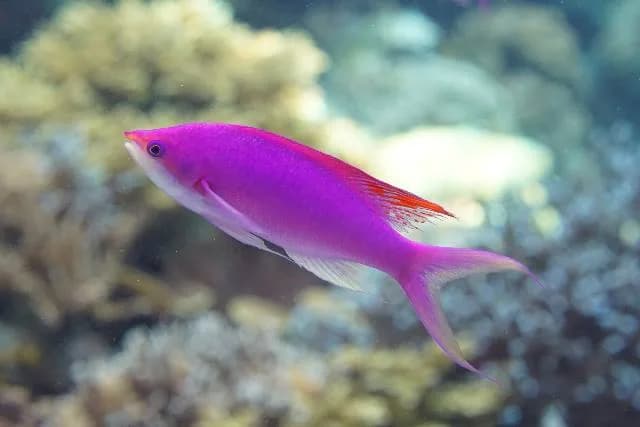
The Amethyst Anthias — also traded as the Purple Queen or Sailfin Anthias — is one of the most visually striking members of the genus. Females are a deep, saturated violet that shifts toward magenta under blue-heavy lighting, with an orange wash around the mouth. Dominant males develop a taller, more elaborate dorsal fin with a red marking at the rear and a more intense overall colour. On wild reefs they form enormous aggregations off steep drop-offs and current-swept walls, feeding continuously on drifting zooplankton.
This species has a well-earned reputation as one of the harder anthias to keep. The core problem is feeding: a significant proportion of imported specimens refuse prepared foods entirely, and a fish that does not switch over will decline within weeks. Many are also collected from deeper water, which adds to the stress load in transit. None of this is a reason to avoid the species outright, but it does mean it belongs with experienced keepers running mature systems, not as a centrepiece for a tank that is still settling in.
Success comes down to three things: buying a fish you have personally watched eat, providing a large system with genuine open swimming room and strong water movement, and committing to multiple small feeds every day for the life of the fish. Meet those conditions and a settled harem is one of the best displays in the hobby. Cut corners on any of them and the outcome is usually poor.
Compatibility
Amethyst Anthias are fully reef safe. They are obligate plankton feeders with no interest in corals, clams, ornamental shrimp or other invertebrates. The only real reef consideration is the nutrient load created by feeding them properly — skimming, export and flow need to keep pace with three or more feeds a day. Toward other fish they are entirely peaceful and are far more likely to be the victim than the aggressor.
Good tankmates are calm mid-water fish that will not monopolise feeding time: fairy and flasher wrasses, clownfish, cardinalfish, gobies, blennies, and tangs in appropriately sized systems. Avoid aggressive damsels, dottybacks and hawkfish, which will harass a timid new arrival off its food, and avoid large angels, triggers, groupers and lionfish outright. Within the species they are haremic and protogynous — all fish begin as females and the dominant individual transitions to male. A harem of one male to five or more females is the natural structure and produces the best display, but the whole group must be introduced simultaneously. Adding females to an established male later almost always results in sustained harassment. Internal squabbling is normal display behaviour rather than serious aggression, but it needs open space to dissipate; crowded groups turn genuinely destructive.
Health & quarantine
Amethyst Anthias arrive stressed and are prone to both parasitic infection and stress-related decline, so a quarantine period is strongly advised — but it needs to be run thoughtfully. A bare, brightly lit quarantine tank is very stressful for a shoaling planktivore, so provide PVC pipe or similar shelter, keep lighting subdued, and maintain the full feeding schedule throughout. Acclimate slowly by drip, then release into a darkened display and leave the lights off for the rest of the day; a panicked first night is the single most common cause of loss, because these fish are notorious jumpers and will launch themselves through any gap in the lid. A tight-fitting lid or mesh screen is mandatory, not a precaution. The earliest warning sign of trouble is body condition rather than any visible symptom — check the belly profile daily, and treat a hollow or pinched abdomen as an urgent problem. Weight loss in a planktivore progresses quickly and is very difficult to reverse once advanced.
Frequently asked questions
Why is the Amethyst Anthias considered so difficult?
Can I keep just one, or do I need a group?
How do I tell a male from a female?
Do they really need to be fed three or more times a day?
Are they safe with corals?
What should I look for when buying one?
Do I really need a lid?
Care guidance is drawn from our own experience — every fish is an individual, so treat it as a starting point, not a guarantee. Not sure if a species suits your tank? Come ask us in store. New to the terms? Read the care-terms glossary.