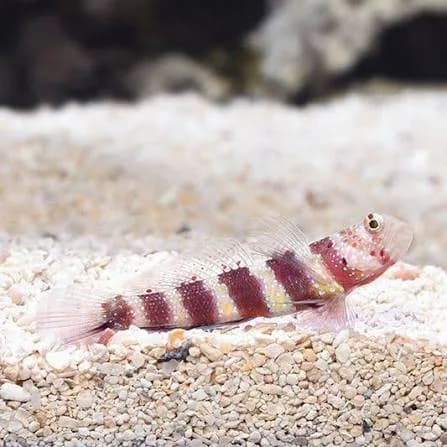
Wheeleri Goby — available now1 in stock
Browse all fish →Overview
The Wheeleri Goby, also called the Gorgeous Prawn Goby or Wheeler's Shrimp Goby, is one of the most colourful of the shrimp gobies. It has a pale body with broad red to orange-red vertical bands, fine blue-to-yellow spotting on the head and fins, and it tends to perch upright at the mouth of its burrow. It is native to sandy and rubble areas of the Indo-West Pacific, including the Great Barrier Reef, where it lives in a partnership with alpheid pistol shrimp.
In the wild the pistol shrimp digs and maintains a burrow while the nearly blind shrimp keeps an antenna on the goby. The goby acts as the lookout and warns the shrimp of danger by flicking its tail. Both animals then dart into the burrow. This relationship can be recreated in an aquarium, and watching a bonded pair is one of the most rewarding sights in reef keeping. However, a Wheeleri Goby will also live well on its own if it has a suitable sand bed and some rockwork to shelter under.
This species is peaceful, small and reef safe, but it is not an ideal first fish. New arrivals can be shy and slow to feed. The goby needs a proper sand bed to feel secure, and like most burrowing gobies it will jump when startled. With a covered tank, calm tankmates and regular meaty feedings it is a hardy, long-lived fish.
Compatibility
The Wheeleri Goby gets along with nearly all peaceful and semi-peaceful reef fish, such as clownfish, small wrasses, firefish, cardinalfish, blennies, anthias and small tangs in appropriately sized systems. Avoid large, boisterous or predatory fish such as groupers, lionfish, large triggers, larger dottybacks and eels. Those fish will either eat it or harass it until it stays hidden in its burrow and stops feeding. Aggressive bottom-dwellers such as some larger hawkfish can also be a problem.
This goby is territorial toward its own kind and toward other shrimp gobies that want the same patch of sand. In most home aquariums keep one per tank, or a known pair. Mixing different shrimp goby species only works in large tanks with plenty of sand area and separate rock structures. The ideal partner is a compatible pistol shrimp such as Alpheus randalli or Alpheus ochrostriatus, but pairing is never guaranteed. Pistol shrimp are generally harmless to fish and corals. Small ornamental shrimp and fish that sleep in the sand, such as some wrasses, can occasionally be disturbed by the digging.
Health & quarantine
Wheeleri Gobies are generally robust once settled. The main risks come from stress and starvation in the first few weeks, plus the usual marine parasites such as marine ich (Cryptocaryon) and velvet (Amyloodinium). Quarantine for at least 4 weeks in a separate system with a sand tray or PVC pipe section for shelter, and confirm the fish is eating well before moving it to the display. If treatment is needed, monitor copper closely; some keepers find gobies less tolerant of high-end copper levels, and tank transfer or other methods are alternatives. Acclimate slowly with a drip, keep lights dim for the first day, and release the fish near sand and a cave so it can dig in straight away. Keep a tight-fitting lid or mesh cover on both the quarantine and display tanks, because jumping is the most common cause of loss with this species.
Frequently asked questions
Do I need a pistol shrimp to keep a Wheeleri Goby?
How deep should my sand bed be?
Why is my new goby hiding and not eating?
Will it bury my corals?
Can I keep two Wheeleri Gobies together?
Does my tank really need a lid?
Care guidance is drawn from our own experience — every fish is an individual, so treat it as a starting point, not a guarantee. Not sure if a species suits your tank? Come ask us in store. New to the terms? Read the care-terms glossary.