Wheeleri Goby & Shrimp Pair
Overview
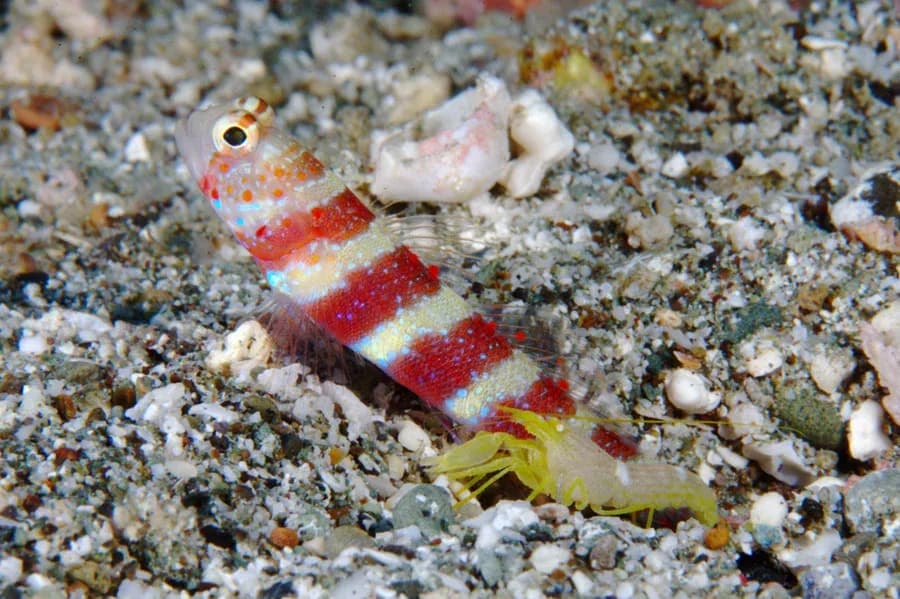
The Wheeleri Goby (Amblyeleotris wheeleri), also traded as the Gorgeous Prawn Goby, is one of the most consistently attractive shrimp gobies available. The body is white to cream with five or six broad red-orange bars, blue speckling across the head and cheeks, and tall, well-marked dorsal fins that are flicked up in display. Most aquarium specimens settle at 7-8 cm; the species is recorded to about 10 cm. It is a burrow-dwelling fish that spends its life within a body length or two of a hole in the sand, so it is best appreciated in a tank with a good open sand footprint rather than a heavily rock-packed aquascape.
What is being sold here is a pair — the goby plus a partner pistol shrimp (usually Alpheus ochrostriatus, A. randalli or A. bellulus). The two share a burrow the shrimp excavates and maintains. The shrimp is functionally near-blind and keeps one antenna in contact with the goby whenever it is out of the hole; the goby watches for danger and signals with a tail flick, and both retreat instantly. It is one of the few genuinely observable symbioses you can keep at home, and it is the main reason to buy the pair rather than the fish alone.
Care is not difficult, but it is specific, which is why we rate this as intermediate rather than beginner. The pair needs a soft sand bed of 5-8 cm with some crushed shell or fine rubble mixed through for burrow structure, all rockwork seated on the glass bottom so the shrimp's digging cannot undermine it, a tightly covered tank because the goby will jump, and small frequent feeds because a shy new fish parked in a burrow is easy to starve out. Meet those four conditions and the pair is hardy and long-lived, with reports of 5+ years in captivity.
Compatibility
Amblyeleotris wheeleri is peaceful toward everything except its own kind. Good tankmates are anything that will not eat it, outcompete it, or bully it away from its burrow entrance: clownfish, small anthias, flasher and fairy wrasses, cardinalfish, blennies, chromis and most dwarf angels. Avoid hawkfish, larger predatory wrasses, lionfish, frogfish, groupers and large dottybacks — a 7 cm goby that sits motionless on the sand is an easy target, and several of those fish will also take the pistol shrimp. Very boisterous feeders (large damsels, big tangs, hungry anthias shoals) are not a danger but will strip the water column before food reaches the burrow, so plan on targeted feeding if you keep them together.
Conspecifics need care: keep one pair, or a confirmed male/female goby pair, unless you have a long tank with 60 cm or more of separation between burrow sites. Two unsexed adults in a standard tank will fight over the burrow and one will be excluded. Other shrimp goby species (Stonogobiops, Cryptocentrus, other Amblyeleotris) can work in larger tanks with distinct burrow zones, but expect posturing along the boundary. The pistol shrimp itself is harmless to fish, corals and inverts — the symbiotic Alpheus species are small, sedentary and not the aggressive predatory pistols people hear stories about. Do note that the shrimp's spoil heaps can bury frags placed near the sand line and can slowly excavate under loose rock, so seat rock on the base glass and keep low-mounted frags off the sand bed.
Health & quarantine
This is a hardy species once settled, with no unusual disease susceptibility, but it is a poor candidate for standard treatments because of its partner. Copper and hyposalinity are both lethal to the pistol shrimp, and formalin dips are risky for it, so you cannot run a conventional prophylactic quarantine on the pair as a unit. The practical approach is a 3-4 week observation quarantine in a bare or thin-sand tank with a length of PVC or a small rubble pile as a burrow, feeding heavily and watching for ich, velvet, flukes and — the real risk — simple failure to eat. If the goby needs copper or a tank transfer, the shrimp must be pulled and held separately; a bonded pair separated for several weeks will usually re-bond, but not always, so weigh that against the risk of importing disease. On arrival, drip acclimate slowly (the shrimp is more sensitive to salinity and pH swings than the fish), and release both into a darkened tank near where you want the burrow, ideally with a small rubble pile as a starter site. Expect the pair to be invisible for the first few days. The most common losses are jumping in week one and slow starvation in month one, not disease — cover every opening in the lid, including the gap around overflow plumbing, and confirm you are seeing the goby eat before you stop worrying.
Frequently asked questions
Do I have to keep the goby with a pistol shrimp?
The goby and shrimp aren't sharing a burrow yet. Did I get a bad pair?
Will the pistol shrimp damage my rockwork or corals?
The snapping is loud. Is something wrong?
How do I quarantine a pair when copper kills the shrimp?
What tank size and layout actually suits them?
Care guidance is drawn from our own experience — every fish is an individual, so treat it as a starting point, not a guarantee. Not sure if a species suits your tank? Come ask us in store. New to the terms? Read the care-terms glossary.